On average a house fly will live around 30 days in the wild.
House flies prefer warmer temperatures, and live longest in temperatures above 70 degrees.
The lifespan of a fly can also depend on the species. For example, fruit flies live a little longer than house flies. These insects die after about 40 to 50 days.
True flies are insects and belong to the order Diptera.
MooMooMath and Science uploads a new Math and Science video everyday.
Birds range in size from the tiny two-inch bee hummingbird to the nine-foot ostrich.
There are over 10,000 species of birds and it is estimated that there are 50 billion birds on planet Earth. So what are some common characteristics of birds?
Let’s take a look at some characteristics of Birds.
Birds are the only living animal with feathers. Feathers help birds fly, but they also help them show off, blend in, stay warm, and keep dry.
All birds lay eggs.
Birds are vertebrates. This means they have a vertebra column that protects a spinal cord.
Almost all birds have forelimbs modified as wings, but not all birds can fly.
Birds are endothermic. This means they can internally generate heat and cool off regardless of the environment.
The lower and upper jaws are modified into a beak that doesn’t have teeth.
The world celebrated when Charles Lindbergh completed a flight of over 3000 miles between New York and Paris. For a bar-tailed godwit, this flight would not even reach halfway on their yearly journey from their summer home in Alaska to their winter spot in New Zealand.
A male Bar-tailed godwit was tracked on his flight from Alaska to New Zealand. The flight was measured at 7500 miles and required 11 days of non-stop flying from the bird.
The common swift holds the record for the longest time flying. During their 10-month migration from Europe to sub-Saharan Africa and back these birds will stay in the air for up to 10 months.
Many people enjoy Tarantulas as pets. Technically Tarantulas are arachnids and not insects. They do live 10 to 30 years which is a long time for an organism with an exoskeleton.
Honey bees are also popular for people to keep around the house but they only live 125 to 130 days.
Some beetles live for 30 years but I don't know many people who keep them as pets.
Ant queens can live 50 to maybe 100 years and many people enjoy ant farms so I will declare the Ant Queen the winner of the longest living insect pet.
Biomes are large ecological communities in response to the climate in an area. Examples of major biomes are: tundra, taiga, temperate forest, grassland, desert, savanna, tropical rainforest, and coral reef.Biomes are important because they provide habitats for plants and animals. They also help to regulate the Earth's climate.
As a result of the different climates biomes differ in,
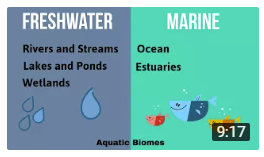
In addition you have marine and freshwater biomes. Marine biomes have a greater salinity than freshwater biomes. Aquatic Biomes can be divided into two major categories.
Freshwater which includes rivers, streams, lakes, ponds, and wetlands.
Marine which includes the ocean and estuaries.
Symbiosis describes a close interactions between two or more different species
There are at least three types of symbiosis, also known as symbiotic relationships.
Mutualism in which both organisms benefit.
Commensalism where one organism benefits and the other organism is neither helped nor harmed.
Parasitism which is when one organism benefits and the other organism is harmed.
Let’s look at some examples of Mutualism.
Each person has a personalized collection of bacteria, called the microbiome.These bacteria found in your digestive tract break down carbohydrates and toxins, and help us absorb the fatty acids. The bacteria in your microbiome also help your immune system and manufacturer some vitamins. In return, the bacteria get a place to live and food to eat.
Termites are nature's recyclers, breaking down the cellulose of trees and decaying wood .Termites cannot digest the cellulose themselves. Instead they depend on a one-celled protozoa in their stomachs that break down the cellulose into simpler compounds that the termites can use as food.
Yucca moths play an important role in the survival of yucca plants. Without the yucca moth, the yucca plant would lose a very important pollinator, and without the plant, the moth would lose a food source.
Commensalism
Hermit crabs live in shells made and then abandoned by snails. This relationship neither helps nor harms the snails.
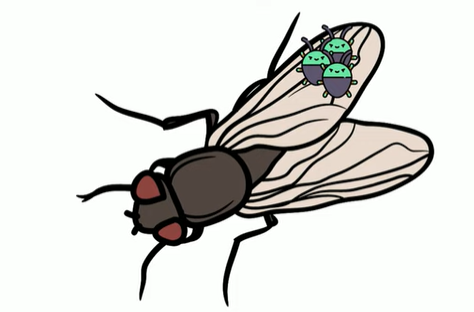
Mites hitch a ride on flies and bees. The mite has a suitable method to grip onto an insect or other animal, and gets transported to another place. A phoretic mite is just a hitch-hiker and does not feed during the time it is carried by its temporary host.
The mites receive transpiration and a place to live and the fly is neither helped nor harmed.
Several orchid species are epiphytes. Which are plants that live and grow on other plants. Some orchids are capable of taking in everything they need directly from the air around them. In these cases the orchid has a place to live and the tree is neither helped nor harmed.
Parasitism
Lampreys are primitive fish with a limited digestive system. They attach to and feed on the body fluids of fish with more advanced digestive systems, often leading to the death of the host fish.
You have lots of examples of worms like the hookworm, and the tape worm that live inside a host and cause all kinds of mayhem.
This example is bizarre. The fungus Ophiocordyceps unilateralis
uses its spores to infect ants and dramatically changes their behavior. Instead of working normally alongside the colony, these ants leave their nest, high in the trees, and make their way down to the lower leaves. Once there the fungus kills the ant, grows inside the head of the ant to release more spores. Kinda weird
• Inertia and Gravity's Role in Planetary Orbits: Planets orbit the sun due to the interplay of inertia (an object's tendency to maintain its motion) and gravity (the attractive force between objects). Inertia keeps planets moving forward, while gravity pulls them towards the sun, resulting in a curved path.
• The Combined Effect of Inertia and Gravity: Inertia causes a planet to travel in a straight line, but gravity continuously pulls it towards the sun, bending its path into an orbit (either circular or elliptical). The balance between these forces maintains the orbit.
• Analogy to a Hammer Throw: The example of a hammer thrower illustrates the concept. The thrower's hand (gravity) and the hammer's inertia work together; the inertia wants the hammer to fly straight, while the thrower's hand pulls it inwards, creating a circular motion similar to a planet's orbit.
Enjoy this worksheet and answer key that go along with the video.
Brightside videos are always very well done and entertaining. Here is how they describe the video "How to Learn More About the Universe. In case you want to take an amazing journey through the Universe from the smallest to the largest objects, this video is a perfect opportunity for you to find out more about the world in a fun and not boring way. "
This video begins with common objects like a whale and eventually compares this to the universe. The video is entertaining. I like this quote from the video, "Carl Sagan told us that there are more stars in the universe than there are grains of sand on all of the Earth's beaches."
This video by " In a Nutshell" does a great job of taking something that is very hard to understand like the scope of the universe and making it simple. Their videos have several billion views.
Have you ever observed geese flying overhead in a V formation and wondered, what are they doing?
Animal migration is the periodic journey of an animal from one place to another and then back again. There are many examples of animals that migrate. Geese are one example. Geese migrate in search of favorable weather, a place to breed, and a food supply. In just 24 hours, these birds can travel 2,214 kilometers from Canada to the southern U.S. or vice versa.
The Grants Caribou is another example of an animal with a long migration journey. These animals travel almost 4000 km in order to reach their calving grounds and find food sources that satisfy their vegetarian lifestyle.
The Arctic Tern will fly more than 17,000 kilometers between their summer home in the Arctic Circle and their winter residence near the South Pole.
Other animals like zooplankton migrate over short distances. During the day, zooplankton migrates to deep dark waters to hide from predators. When the sun starts to set, zooplankton rises back to the surface to eat under the protection of darkness.
Why do animals migrate?
There are several reasons.
Animals may migrate in order to avoid cold temperatures. Geese are an example of animals who migrate south in the winter in search of warmer temperatures.
Animals may migrate in order to find food. The Grants Caribou’s diet consists of specific plants such as willows, sedges, and lichens. Caribou must travel continuously to find adequate food. The bar-headed goose migrates over the Himalayas to spend the winter in parts of South Asia where it feeds on barley, rice and wheat.
Animals may migrate to an area that provides a more favorable environment for reproduction. Two fish species serve as examples of animals that migrate for reproductive reasons: the salmon and the alewife. Salmon migrate each year to their home rivers and streams to reproduce. Salmon must travel upstream and often have to make impressive leaps over rapids and low waterfalls to reach their breeding grounds. These fish have the ability to jump nearly 12 feet in the air! Though alewives spend most of their lives at sea, they will migrate back to freshwater during the spring to spawn. Female alewives can lay up to 300,000 eggs!
Insects even migrate. Some winged insects such as locusts and other flying insects like butterflies migrate every year. The monarch butterfly migrates from southern Canada to a warmer climate in central Mexico where they spend the winter and mate.
Annually, mass migration events occur in the Serengeti. 1.7 million wildebeest and hundreds of thousands of large game animals such as gazelles and zebras follow circular patterns of movement looking for new and more abundant food sources.
So maybe, the next time you get an urge to go on a road trip or a long walk, it may be your inner compass telling you it is time to migrate.






.png)
