Here are several basic facts to help you understand Genetics.
• Mendel's Pea Plant Experiments and the Foundation of Genetics: Gregor Mendel's experiments with pea plants between 1856 and 1863 established fundamental principles of heredity. He observed seven characteristics (e.g., plant height, flower color, seed shape) and identified dominant and recessive traits, laying the groundwork for understanding gene inheritance patterns.
• Genotype and Phenotype: Mendel's work introduced the concepts of genotype (the genetic makeup, using homozygous dominant, heterozygous, and homozygous recessive pairings) and phenotype (the observable physical traits). He showed how the interaction between these determines the expressed characteristics.
• Alleles and Homozygous/Heterozygous States: Mendel's findings led to the understanding of alleles (different forms of the same gene), homozygous (identical alleles for a trait), and heterozygous (different alleles) states. This understanding formed the basis for future advancements in genetics, including DNA mapping and fingerprinting.
Please check out our YOUTUBE channel. We have created 3200 videos, have had 170 million views, and have 530,000 subscribers.
Learn how to convert a strand of mRNA into a polypeptide which is a chain of amino acides. This is called translation and it is one step of protein synthesis.
mRNA is created from a template of DNA and uses the same bases except uracil replaces thymine.
The strand of messenger RNA is always read from the 5 prime end towards the 3 prime end in triplets called codons. A codon is a DNA or RNA sequence of three nucleotides.
There are three guidelines that should be followed when translating the mRNA.
Always starts at AUG
3 Stops UAA UAG UGA
Always reads 5’ to 3’
A codon chart will need to be used in order to translate the codon to an amino acid.
Here is a list of the 20 Amino Acids that go along with the Codon Chart.
The basic unit of life is the cell. Inside the cell of eukaryotic individuals is the nucleus.
The nucleus looks like a dark spot but contains the DNA.
A DNA molecule is made up of two strands of the sugar deoxyribose and phosphate and then it has rungs like a ladder. The rungs of the ladder of DNA are adenine, thymine, cytosine and guanine.
Your DNA is divided into shorter segments called chromosomes.
Humans have 23 pairs of chromosomes and during cell division the DNA condenses and wraps around proteins and creates chromosomes.
Your chromosomes have shorter segments called genes.
The sum of all your genetic material is your genome.
Your DNA is very stable and can last thousands of years.
Your DNA is an instructional manual for making you. DNA passes information extremely accurate and only makes an error per billion letters copied or three errors per cell division.
Most of these mutations your body can ignore but some have lasting impact.
Your DNA keeps your line of existence going. The genes you carried are ancient and will continue as long as your line produces offspring.
What genes specifically do is provide instructions for making proteins.
Some proteins speed up chemical reactions called enzymes.
Some proteins past chemical messages called hormones, while others attack pathogens called antibiotics.
We are all very different but genetically almost identical. All humans share 99.9% of our DNA, and our DNA differs in only three or four million places. This is a small amount compared to the total but enough to make a difference.
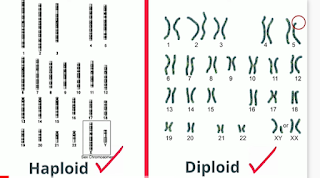
These two karyotypes will help us understand the difference between a diploid cell and a haploid cell.
Before we get started let’s talk about two types of cells found in the body.
Somatic cells are cells found in the body.
In humans, examples would include bone cells, muscle cells, and nerve cells. Gametes include egg cells and sperm cells Ok back to the karyotypes. Diploid cells have paired chromosomes and are represented with 2n the n stands for the number of chromosomes.
In humans, there are 23 pairs of chromosomes or 46 chromosomes in each diploid cell. Haploid cells have 1 chromosome which is represented with a n. Notice that there are 23 chromosomes.
Diploid cells are found in somatic cells or body cells.
Haploid cells are found in gametes or your egg and sperm.
In this lab you will get the opportunity to see what DNA actually looks like.
All items that you will need can be found at your local grocer.
Items you will need for the lab.
*Rubbing Alcohol
*Salt
*Banana
*Dish Detergent
*Two clear containers-Glass or plastic
*Spoon
*Cheesecloth
*Paper towels
* Plastic bags
Step 1. Place 1 tablespoon of salt,3 table spoons of water, and 1/2 of a banana in a plastic bag.
Step 2. Smash up the banana until it is has the texture of baby food.
Step 3. Strain the liquid from step 2 through the cheesecloth into a glass or cup.
Step 4. Gently stir in one table spoon of dish detergent.
Step 5. Pour in the rubbing alcohol down the side of the container. This allows the DNA to float to the surface.
Step 6. Use a toothpick and extract the DNA
If you have a microscope you can place the DNA on a slide and look at the DNA. I have completed this activity many times and I have found it has a very high success rate.
If you have any questions the video should be helpful.
What is DNA?
Excellent animated video covering the details of DNA. This video has over 1 million views.
What is DNA
This is a very detailed site produced by the National Library of Medicine. RNA Khan Academy
This is a very helpful page on RNA by Khan Academy. It does a great job of explaining this complex topic.
DNA vs RNA
This page gives a chart explaining how DNA is different than RNA. The chart is really helpful.
DNA vs RNA
This article compares DNA and RNA. The article gives 7 ways these two nucleotides are different. For more Math resources visit me on Pinterest
Alleles In genetics,alleles are different forms of the same trait. Traits are characteristics that can be passed from one generation to another. All of the followings would be examples of a trait.
Hair color
Skin color
Height
Chin shape,
Gender
A gene is a portion of DNA that contains the genetic code for a trait. Genes are located on chromosomes. Here is a picture.
For each trait, you get half of the information from mom and half from dad. As a result, you get different forms of the same trait.
These different forms are alleles. Gregor Mendel, who is considered the father of genetics studied 7 traits of pea plants.
For example, the color of the flower can be white or purple. The pea plant can be tall or short. For all 7 traits, each trait has at least two different forms. These would be examples of alleles. Different forms of the same trait. Look at this picture of eye color.
The trait is eye color, and the alleles are the different colors.
One last example, the shape of the chin is the trait, and the allele would be if it is cleft chin
In this video recording,I review how to create and solve Punnett squares. The Punnett square is a diagram that is employed to predict an outcome of a specific cross of plants or animals. Reginald C. Punnett devised the methodology. The diagram is employed by biologists to look for the possibility of an offspring having a specific genotype. To be able to solve a Punnett square let's review some basic vocabulary. Trait A feature that may be transmitted from one era to another. A good example of a trait would be skin color. An allele is another form of the same trait. Having different eyes color would be a good example of an allele. Homozygous dominant would be written with two capital letters. A dominant trait is written with a capital letter. A Homozygous recessive is written with two lower case letters. The only way a recessive trait appears is if you have two lower case letters. Finally, a heterozygous genotype has two different letters. The steps for establishing a Punnett square are the following.
Draw the Punnett Square.
Write the genotype of the parents at the top and on the sides of the Punnett square.
Traits are characteristics or features that can be passed from one generation to another.
The picture of various dogs below illustrates several different traits of dogs.
Some examples of traits include hair color, height, ear shape, nose shape, size of their teeth, and even the sound of their bark.
Each of these factors can be passed genetically to another generation.
Alleles are different forms of the same trait.
In this picture notice the different shapes of the noses. These would be examples of alleles because they are different forms of the same trait.
Traits can also be dominant or recessive.
For individuals that reproduce sexually, they receive two alleles for each gene, one coming from the female parent and the other from the male. A dominant gene can be expressed even if only one copy of the gene is present. The dominant gene will mask or override the recessive gene.
A recessive trait will only be expressed in an individual who inherits recessive alleles.
Gregor Mendel was one of the first individuals to study traits. He bred pea plants and studied several different traits of these plants.
The pea plants had several traits Gregor Mendel could easily study such as the type of seeds, flower color, or color of the pod. Each trait had different forms which we call alleles. For example, the pod could be yellow or green.
Traits are different than acquired characteristicswhich are non-inheritable characteristics. In other words, they are characteristics that are caused after birth by disease, injury, accident, deliberate modification, or repeated use. For example, your skin color is inherited from your parents, but changing your skin color by getting a tattoo is not a trait because your offspring will not inherit the tattoo.
In summary, a trait is a feature that can be passed from one generation to the next.