Help students practice counting atoms in chemical formulas and equations with this easy-to-use fill-in-the-blank worksheet. Students work with subscripts, coefficients, and parentheses, then practice counting atoms in chemical equations.
Includes:
Counting atoms in compounds
Subscripts, coefficients, and parentheses
Counting atoms in equations
Fill-in-the-blank practice
Complete answer key
Editable Canva link for easy customization
Great for classwork, homework, review, science centers, or sub plans. Print and go or customize it to fit your classroom!
Video Summary: Endothermic and Exothermic Phase Changes
The video explains that phase changes are physical changes where a substance transitions between states of matter, such as solid, liquid, or gas. These changes can be:
Endothermic, meaning they absorb heat from the surroundings, causing the surroundings to cool down.
Examples:
Melting (solid → liquid)
Vaporization (liquid → gas)
Sublimation (solid → gas)
Exothermic, meaning they release heat to the surroundings, causing the surroundings to warm up.
Examples:
Freezing (liquid → solid)
Condensation (gas → liquid)
Deposition (gas → solid)
To remember the difference:
Endothermic sounds like “into” – heat flows into the substance.
Exothermic sounds like “exit” – heat exits the substance.
The video explains the differences between atoms, molecules, and compounds:
An atom is the smallest unit of matter, made of protons (positively charged), neutrons (neutral), and electrons (negatively charged). Protons and neutrons are located in the nucleus, while electrons orbit around it. The atomic number is determined by the number of protons.
A molecule forms when atoms are chemically bonded, often by sharing electrons (covalent bonds). Molecules can be made of the same type of atoms (e.g., ozone) or different types (e.g., water: H₂O).
A compound is a type of molecule made from different elements bonded together chemically (e.g., sugar made from carbon, hydrogen, and oxygen).
Additionally, an element is a pure substance made up of only one type of atom and is listed on the periodic table.
A solution is a mixture of two or more substances.
Properties of a Solution
The particles in a solution cannot be seen.
Light is not visible when it passes through a solution.
A solution cannot be separated with a filter.
A solution is a homogenous mixture.
An example would be sugar and water. The sugar is the solute and the water is the solvent. The solute is the item being dissolved and the solvent is what the item is being dissolved into.
This may help you remember the difference between solute and solvent. Think of placing the loot into a vent to hide it. So the soLOOT goes into the solVENT.
A suspension is a mixture of a fluid with undissolved particles in it.
Properties of a Suspension
The solid particles may be visible and will settle over time.
The particles of a suspension can be filtered out.
Light is visible when it passes through a suspension.
A suspension is considered a heterogenous mixture.
The solid particles are called the internal phase and the fluid is called the external phase.
An example would be muddy water and sand in water. The sand does not dissolve into the water but is mixed into the water and will settle over time.
Light is visible when it passes through a colloid.
You cannot use a filter to filter out what is dispersed and the particles do not settle over time.
A colloid is a homogenous mixture.
Examples of a colloid include, glue, milk, and fog.
A colloid has a dispersed phase (the suspended particles) and a continuous phase (the medium of suspension).The continuous phase can be a solid,liquid,or a gas.
Let's take a look at the difference between physical properties and chemical properties.
Physical properties are properties that describe the physical characteristics of a substance and not how the substance behaves chemically.
A chemical property on the other hand are properties of matter that become evident after a chemical reaction.
Let's take a look at nine physical properties.
Luster Is the object shiny or dull?
Hardness Can the object be scratched?
Ductile Can it be pulled into a wire?
Malleable Can you bend it?
Conductive Will heat or electricity move through it?
Density How heavy is it for its size? Density is a measure of mass divided by volume.
Solubility How easily can it dissolve?
Melting point At what temperature will it melt?
Boiling point At what temperature will it vaporize?
Now let's compare these with some chemical properties and this is not every a list of every single chemical property but an example of several.
Flammable How easily will the substance react when exposed to an open flame?
Radioactive How the nucleus of the atom is going to change.
Oxidizer This is a substance that promotes combustion in other materials. An example is when you mix nitric acid with copper and it creates a cool brown gas.
Corrosive Can the objects rip off electrons from metals.
Toxic This is a substance that can be poisonous or cause harmful health effects.
Explosive A substance that contains a great amount of potential energy that can produce an explosion.
PH This is the potential of hydrogen and it's a measure of how acidic or basic a substance is.
Additional Chemical Properties
Heat of Combustion At what temperature will the object ignite.
Reactivity A measure of how much a substance reacts when it is mixed with another substance.
Enthalpy Is the sum of the objects internal energy.
For example, omega-3 fatty acids help your brain function normally and are known to be anti-inflammatory. On the other hand, Saturated fats raise the level of unhealthy cholesterol in your blood. This puts you at a higher risk of heart disease and stroke.
Let's take a look at the difference between saturated fats and unsaturated fats.
A fat molecule is composed of a 3 carbon glycerol head and three fatty acid tails.
The tails are a chain of carbons bound to hydrogen atoms. This is called a hydrocarbon chain.
When all of the carbons are bound to hydrogen you have saturated fat.
All bounds between the carbons and hydrogen are single which creates a straight shape.
Due to this straight shape saturated fats are solid at room temperature. Examples include animal fats.
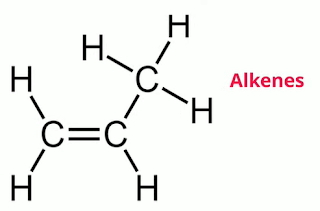
An unsaturated fat has a hydrocarbon chain that contains carbon atoms that bind to each other with a double bond.
These double bonds bend the unsaturated fat which makes the fat less compact and usually liquid at room temperature. Examples include plant and fish fats.
An unsaturated fat with one double carbon bond is a monounsaturated fat.
An unsaturated fat with multiple double carbon bonds are polyunsaturated fat.
An unsaturated fat that has the hydrogen atoms on opposite sides of the carbon is called a trans fat. This creates a structure that is more similar to a saturated fat and results in an unsaturated fat that is solid at room temperature.
Trans fats are not healthy fats. They increase the bad LDL cholesterol and lower the good HDL cholesterol.
In general unsaturated fats are healthier than saturated fats and trans fats..
Some unsaturated fats help the nervous system and decrease the risk for heart disease by decreasing the bad LDL cholesterol and increase good HDL cholesterol.
When certain elements interact, a chemical reaction may occur.
Let’s take a look at the difference between reactivity and combustion.
Reactivity is the chemical reactions of a single substance or two or more substances that interact with each other. Highly reactive substances may react explosively, while other reactions may include fizzing, or a change in color.
Reactivity depends on the arrangement of the valence electrons.
Let’s look at sodium and neon for understanding of this concept.
Sodium has 11 electrons and neons has 10.
They both have 2 electrons in the inner shell and 8 in the second shell but sodium has one electron in its outer shell. Elements desire to have their shells filled up so neon is happy with 8 electrons in it’s outer shell. Sodium has only one electron in it’s outer shell so it is very unhappy. Sodium can easily lose one electron in its outer shell in a chemical reaction so it is highly reactive.
Here is sodium reacting with water.
Combustion is a chemical process in which a substance reacts rapidly with oxygen and gives off heat. The original substance is called the fuel, and the source of oxygen is called the oxidizer.
The fuel combines with oxygen and releases energy in the form of heat, light, and sound.
Two Combustion Reactions
Coal + oxygen yields carbon dioxide + energy
Hydrogen + oxygen yields water + energy
This can be an explosive reaction if you add heat.